The Data Gap Costing Aesthetics Practices More Than They Realize

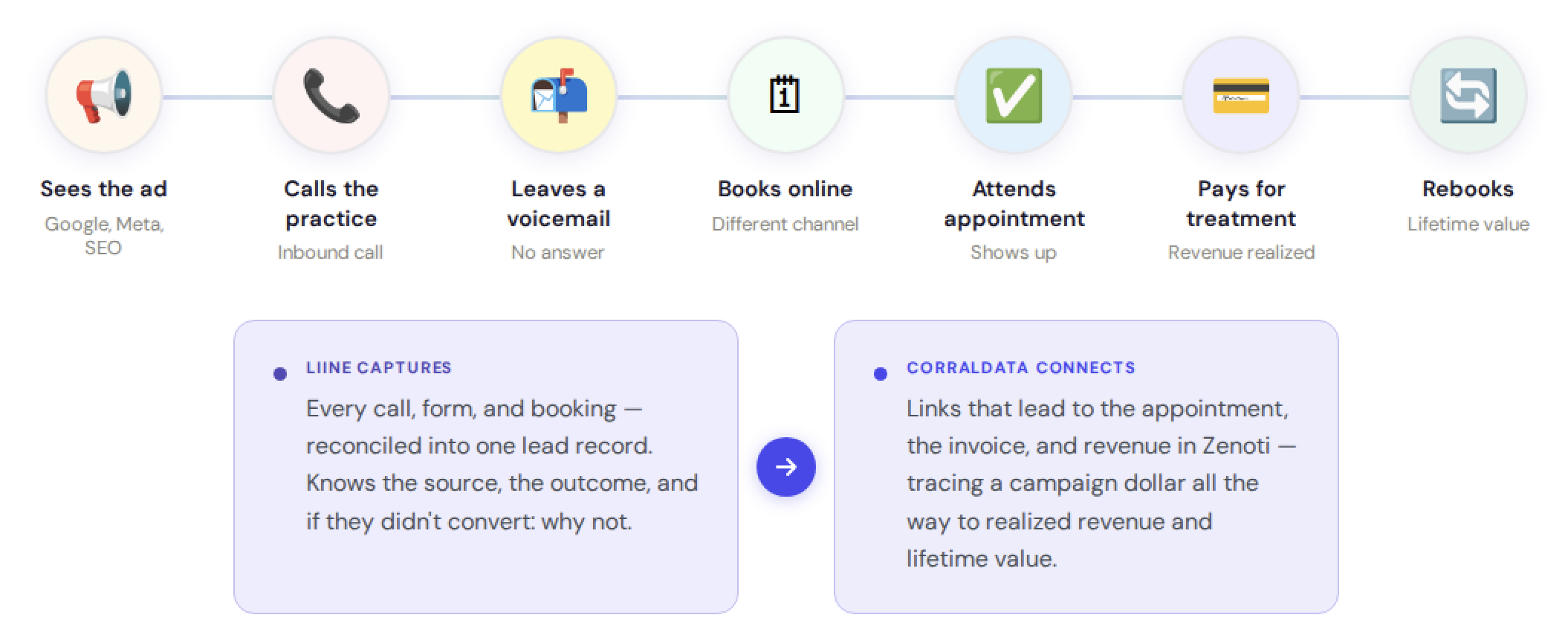
Picture a familiar scenario. A prospective patient sees your Google Ad, calls the front desk, leaves a voicemail, then later finds your Instagram, books online, and shows up for an appointment. To your CRM, that might look like two separate leads. To your EMR, it starts at the booking. To your marketing platform, it ends at the click.
Nobody — not the CMO, not the COO, not the agency — can see the whole thing. That's not a technology problem. It's a data connection problem. And for multi-location aesthetics practices spending real money on patient acquisition, that gap has a real cost.
According to Liine's 2026 Healthcare Marketing Benchmark Report, practices are converting only about 59% of new patient contacts into booked appointments. That means nearly half of every lead your marketing generates goes somewhere unknown — not tracked, not followed up on, not learned from. At one location, that's a missed opportunity. Across ten or thirty, it's a portfolio-level problem.
This piece is about how to close it.
Two tools, one connected picture
For aesthetics practices that want to connect their marketing data with their EMR, there’s finally a way to bridge this data gap. Liine captures the full patient acquisition story. CorralData connects it to your business. Put them together and the picture you've been missing — from first call to full revenue — finally comes into focus.
Liine is an AI-powered call tracking, marketing analytics and ad optimization platform built specifically for healthcare and aesthetics practices. It captures every new patient interaction across every channel — inbound calls, web forms, online bookings — and uses AI to analyze what happened at each touchpoint. Liine identifies whether a contact is a true new patient or an existing one, reconciles multi-touch interactions into a single lead record, and records the reason a lead did or did not convert. The result is a clean, deduplicated view of your actual patient acquisition pipeline, with full context on what's driving, and blocking, conversion at every location.
CorralData is a business intelligence platform purpose-built for multi-location healthcare and aesthetics practices. It connects your EMR or practice management system (like Zenoti), your marketing channels, and other data sources into a single analytics layer — then surfaces the metrics that drive decisions at scale. Where most reporting tools start at the appointment, CorralData starts earlier and goes further: which campaigns actually produced revenue, which providers are outperforming, where your schedule has capacity that marketing isn't filling. And unlike most reporting tools, it doesn't stop at the insight — CorralData uses AI to help you act on what it finds. That means surfacing the right opportunities to the right people, with enough context to know what to do next.
Use cases that change how you operate
Here's what becomes possible when the two platforms work together — and why it matters for practices operating at scale.
1. Connecting campaign spend to actual patient revenue
Most relevant to: CMOs, VPs of Marketing
Most marketing attribution for aesthetics practices stops at the lead or the booked appointment. That's not where the value is. The value is in which campaigns drove patients who actually showed up, completed treatment, generated revenue, and came back.
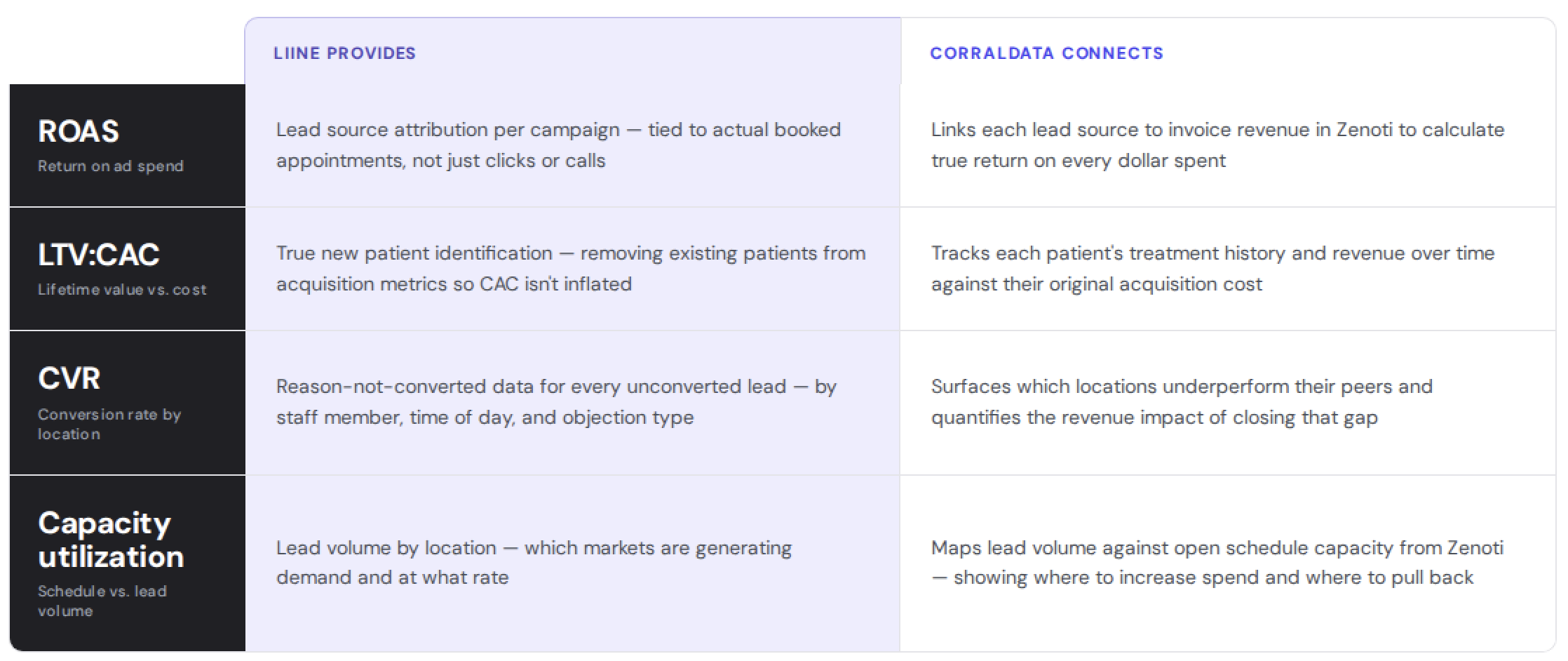
Liine connects every campaign source to the leads it generates and whether those leads converted. CorralData then links that lead data to appointment, invoice, and rebooking records in Zenoti — closing the loop between Liine's marketing intelligence and your EMR revenue data. Not estimated. Not projected. Actual dollars tied to actual patients.
This also surfaces where marketing dollars are being spent in markets where schedule capacity is already full — and where there's untapped capacity that campaigns should be filling.
2. Knowing your true lead count — and what it's actually telling you
Most relevant to: CMOs, COOs
Before you can trust your conversion rate, you need to trust your lead count. For most medspas, that number is wrong, and not by a little.
Leads arrive through half a dozen channels simultaneously: inbound calls, missed calls, web forms, online booking platforms. Each one lives in a different system. None of them talk to each other. A patient who calls twice and then books online might show up as three separate leads — or none at all, if the calls went unlogged. The result is a total lead count that's either inflated with duplicates or deflated by blind spots, and a conversion rate built on top of it that can't be trusted.
Liine solves this at the source. It captures every inbound interaction across all of your lead channels, identifies whether each contact is a true new patient opportunity, and reconciles multi-touch journeys into a single lead record. CorralData then connects that accurate lead count to downstream funnel metrics so every ratio your team is making decisions on is built on a number that actually reflects reality.
When your lead count is right, everything downstream gets more reliable: CAC, ROAS, conversion benchmarks, headcount planning. All of it.
3. Turning unconverted leads into an ops and training roadmap
Most relevant to: COOs, practice operators
Roughly half of all new patient contacts never convert to a booked appointment. Liine doesn't just capture that a lead didn't convert — it captures why. Pricing objection, availability, caller procrastination, treatment not offered, insurance not accepted. That's a data type most practices have never had access to at scale.
CorralData takes that signal and puts it in portfolio-level context, so the question isn't just which locations are losing leads to caller procrastination, but what that gap is worth in revenue across all of your locations, and where to fix it first. These answers don't just identify problems — they rank them by revenue impact and point directly to where intervention will move the needle. A conversion gap at one location is a coaching conversation. Across fifteen locations, it's a portfolio risk — and one that's now measurable.
4. Closing the loop with your local teams
Most relevant to: COOs, regional operators, practice managers
Data at the portfolio level is only as useful as what happens at the location level. The final — and often overlooked — benefit of connecting Liine and CorralData is what it does for the people running each market day to day.
When local teams can see exactly where their leads are coming from, where they're losing patients, and how their conversion performance compares to peer locations, the dynamic shifts. Training conversations become specific instead of general. Performance reviews are grounded in data, not perception. Front desk staff understand where the gaps are and what closing them is worth.
The practices that get the most from this combination aren't just using it to report upward — they're using it to build more capable, better-informed teams at every location. That's where the compounding value lives.
Questions you can now answer
For marketing leaders:
- What is our true cost per acquired patient, by channel and location?
- Which campaigns are driving patients who actually show up and generate revenue — not just leads?
- Where are we losing patients in the funnel, and is it a marketing problem or an operations problem?
- What is our ROAS when "return" is measured as actual revenue, not booked appointments?
For ops and practice leaders:
- Which locations have unconverted lead volume that front desk training would actually address?
- Where do we have open schedule capacity that our current marketing isn't filling?
- Which providers and locations are driving the highest patient lifetime value?
- Which markets are losing patients to availability issues — and what would it take to fix them?
The connection you've been missing
Every interaction, every campaign, every appointment — it's already being generated. It lives in Liine, in your EMR, in your ad platforms. What's been missing isn't more data. It's the layer that connects it and makes it mean something.
Aesthetics practices that can see their full patient acquisition picture — across every location, every channel, every team — are making better decisions faster than the ones that can't. Not because they have more resources, but because they've connected what they already have.
That connection is what Liine and CorralData are built to create.
See how Liine and CorralData work together in your stack: Book a demo with CorralData or learn more about Liine here.
Related Articles:

Zenoti and CorralData Partner to Redefine the Future of Health and Wellness Intelligence



Scaling Your MedSpa from One to Multi-Location: The KPIs, Systems, and Data That Actually Matter

.avif)

.avif)